

The Digital Al Capone
Why Product Liability is the New “Tax Evasion” for Big Tech

Listen to the audio briefing above to hear the 2026 'Digital Al Capone' legal strategy. Upgrade to a paid subscription to unlock the full audio and see the Sheryl Sandberg receipts below.
In the 1930s, the federal government couldn’t pin a murder on Al Capone, so they sent him to Alcatraz for tax evasion. It was the ultimate “end run”—if you can’t get them on the big stuff, you find the hook they can’t wiggle off of.
For a decade, Section 230 has been the “big stuff” for Big Tech. It’s the impenetrable shield that lets them shrug off responsibility for the horrors hosted on their platforms by claiming they are mere “neutral conduits.” But as the landmark trial in Los Angeles unfolds this month, we are seeing a new tactical weapon: Product Liability.
The Pincer Movement: Silicon Valley to Atlanta
My “inclination” all those years ago was correct. I knew we could forget about Congress acting on Section 230. They are now as deeply in the pockets of Zuckerberg and Alphabet as the NRA has always owned the Republican party. With Big Tech spending a record $61.5 million on lobbying in 2024 alone—and Meta hitting new quarterly highs in 2026—waiting for a legislative fix is a fool’s errand. They’ve bought the referees. Even as the 2026 bellwether trials began, Meta’s lobbying machine was working to “neutralize” state-level design liability bills before they could even hit the floor.
So, we go for the “end run.” The plaintiffs in California aren’t suing over what is on the screen; they are suing over how the screen is built. By focusing on “design liability,” they are targeting the architecture—the addictive infinite scroll and the predatory algorithms—as defective products. Judge Carolyn Kuhl’s decision to allow this trial to proceed proves that while Congress is paralyzed by tech money, the courts are finally smelling the “digital fentanyl.”
The Legacy Media Wall and the Sandberg Lie
The rot isn’t just in Silicon Valley; it’s in the legacy media companies that enable them. Gray Television owns a key to the lock—the copyright to the footage of Alison’s murder—and they spent years gaslighting me to keep it after I appealed to their sense of goodwill.
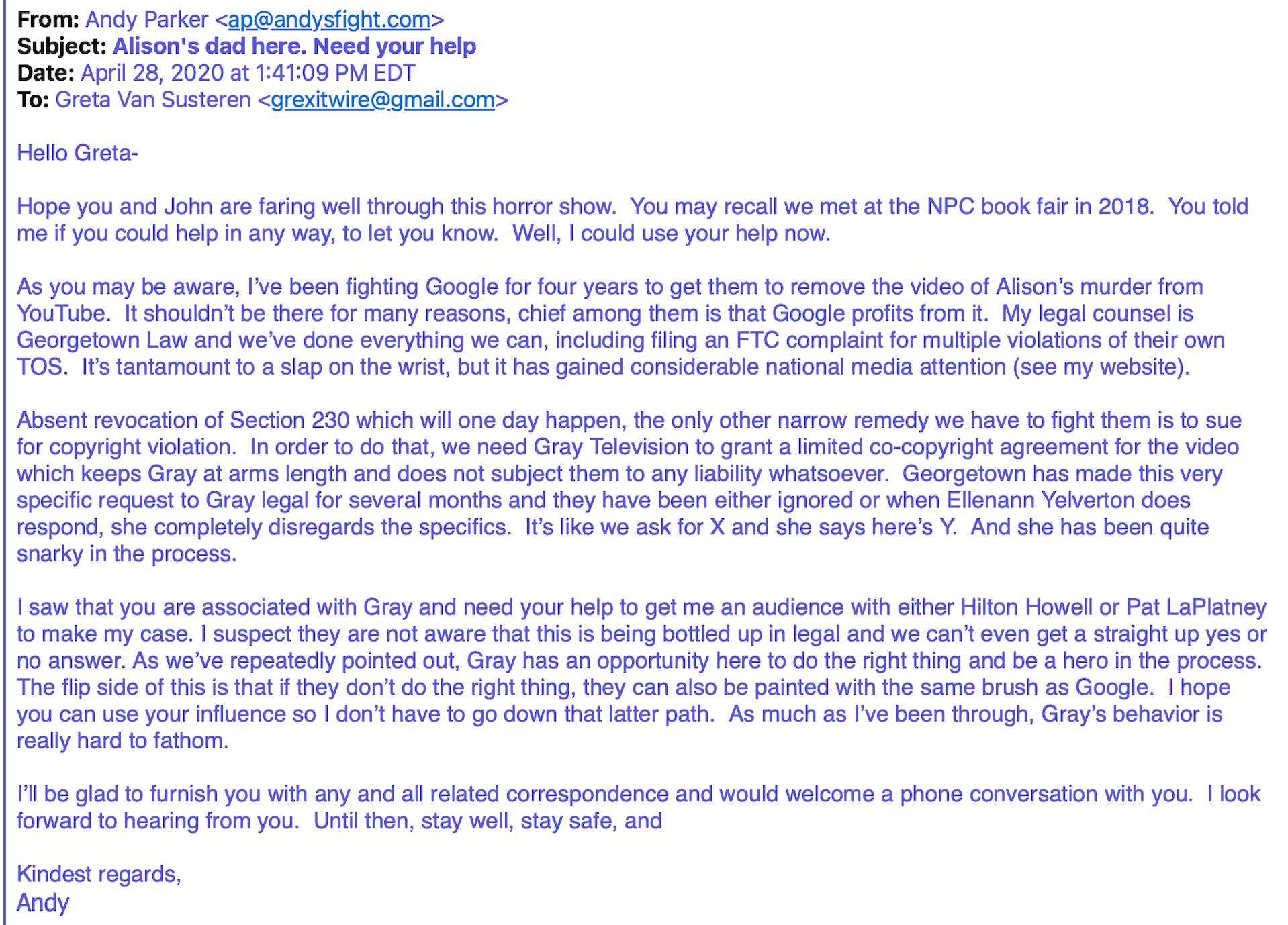
Of course I received no response from my erstwhile pal.
Then there is this act of utter deception. In 2020, Sheryl Sandberg told Ambassador Marc Ginsberg that the video had been “removed and saved to prevent future uploads.”
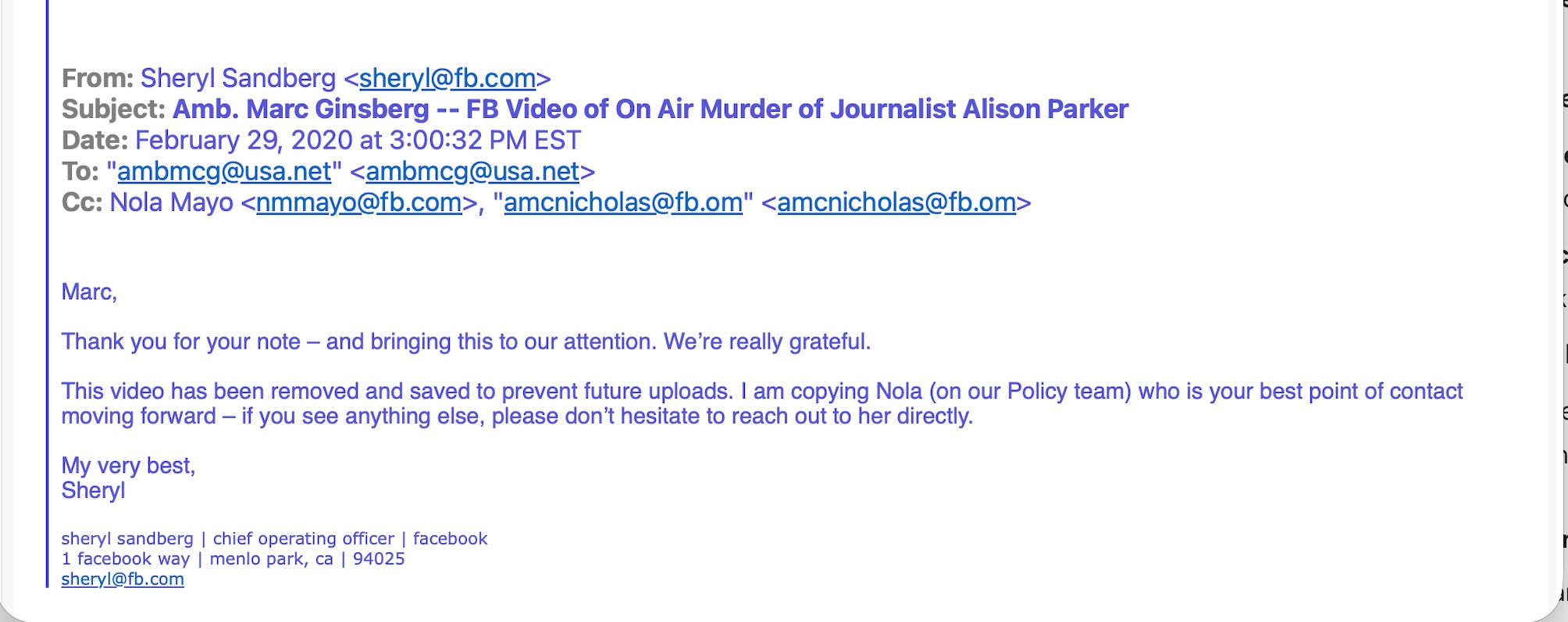
This email isn’t just a lie; it’s a legal confession. In the world of product liability, once a manufacturer knows their product is causing harm, they have a “post-sale duty to warn.” Sheryl Sandberg’s 2020 claim that Meta had “removed and saved” the video to prevent future uploads proves they recognized the danger. But instead of warning the public that their “safety tools” were failing, they doubled down on the deception.
Just as Big Tobacco was taken down for hiding the science of addiction, Meta is now facing a reckoning for hiding the truth about its own engineering. By claiming the problem was solved while their algorithms continued to serve up this horror, they transitioned from negligence into willful misconduct. They didn’t just build a defective machine; they disabled the alarms and told us it was safe to stay inside.
Meanwhile, Gray’s Chief Legal Officer, Kevin Latek, performed semantic gymnastics to claim the footage didn’t show the shooting. While they stonewall, they promoted: Ellenann Yelverton, who met my pleas with snark and disregard, was rewarded with a promotion to General Counsel of Gray Media in 2025.
