

The God Question
On grief, faith, and the question polite religion never asks.

Time once again for a break from the shitshow this week.
In past essays I’ve acknowledged my profound admiration for the genius of Stephen King and his ability to weave relatable emotions into his characters and stories. Sometimes, as with the latest book I’m listening to, Revival, it hits you like a ton of bricks.
I’ve only gotten about two hours into it, in what I’ve been warned is existential darkness. Chapter 3 got me. I’m not going to give away the plot because at this point I’m not sure where it’s all going. But King always hooks you in and keeps you, and that chapter resonates with those of us who have experienced unexpected and tragic loss.
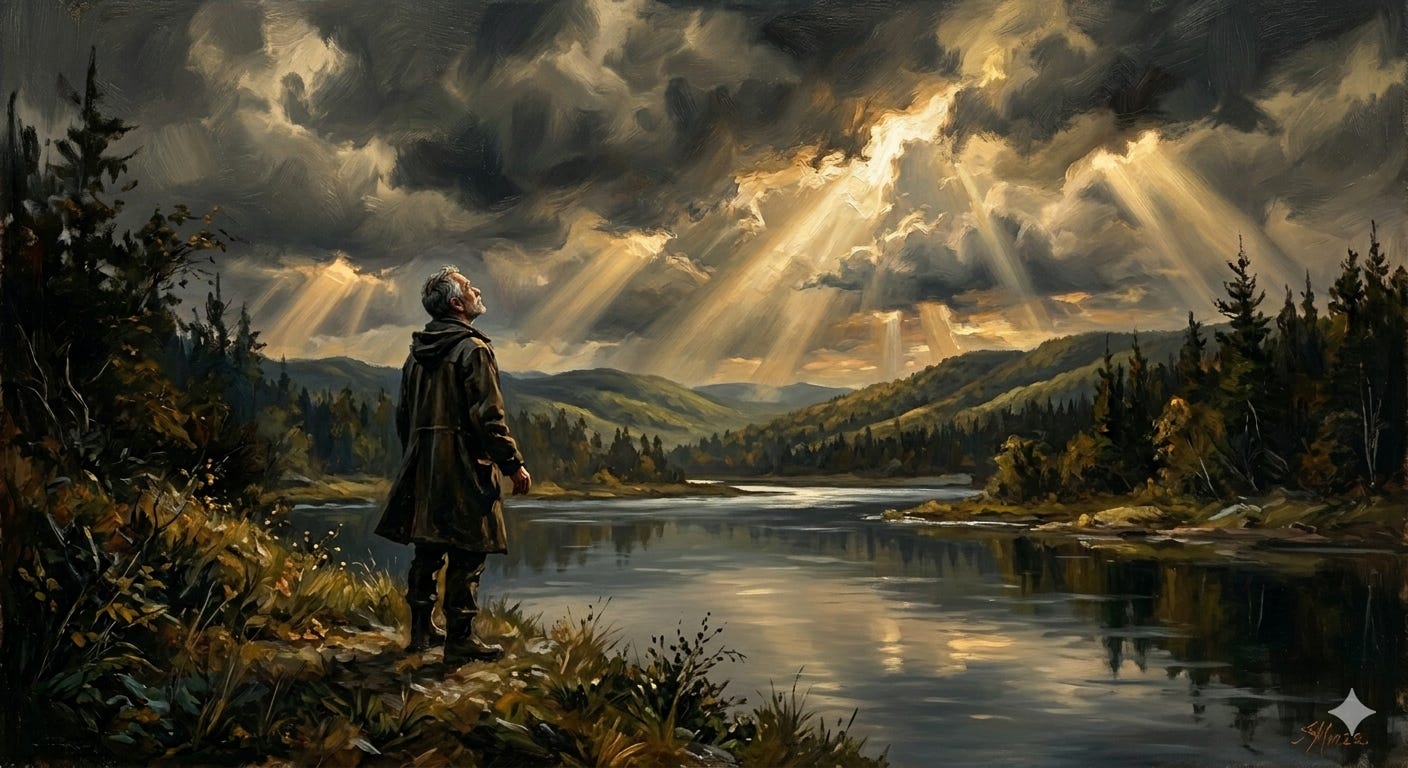
His characters reflect all of us. Some find comfort in religion. Others, like me, do not. As I wrote in For Alison, the afternoon she was killed I went to the spot on the Smith River where we launched our kayaks for all those wondrous journeys.
We’d been coming here together for years. Alison and Chris and Barbara and I had launched our kayaks at this very spot just last month, on the Fourth of July. It’s where I was the day before. The day before. What I wouldn’t give to go back. Just twenty-four hours earlier, I’d been so proud of my success, the centerpiece of my bid for reelection to the Henry County Board of Supervisors. Just twenty-four hours earlier, Alison had been alive. Now she wasn’t. And now nothing else mattered.
I gazed downriver and for a split second I saw her paddling around the bend, a big smile on her face. How could it be that I’d never see that smile again, except in memory? I ached to hold her in my arms again.
I stood there, bitterness and resentment and anger rising within me, rage and vitriol and bile, and then I erupted with all the force of Etna, Pompeii, and Mount St. Helens put together.
This time it was directed toward God. I’ve never been particularly religious, but I gave that bastard an earful. People always tell me that it was Alison’s time to go, that God called her home. What a stupid fucking thing to say. What kind of comfort is that? What kind of God would do something like that? Not any God I want to know, that’s for damn sure.
When I ran out of expletives to hurl skyward, I collapsed onto the closest boulder, totally spent.
Reading Chapter 3 brought it all back.
King’s pastor stands before his congregation after the unthinkable and asks the question that polite religion never permits: what kind of God would do this? I didn’t need to imagine the answer. I’ve been living it for eleven years.
People mean well. I know that. But “it was God’s plan” and “He called her home” are things people say because silence feels inadequate and truth feels cruel. The truth is there is no comfort in those words. Not for me. Not for Barbara. Not for anyone who has stood at the edge of a river talking to a God they’re not sure they believe in anymore, screaming into the sky until there’s nothing left.
King understands something that a lot of writers are afraid to touch — that grief doesn’t make you more faithful. Sometimes it makes you furious. Sometimes it makes you empty. And sometimes, on the banks of the Smith River with the water moving past you like nothing in the world has changed, it makes you both at once.
Revival is not a comfortable book. I was warned it was existentially dark and three chapters in I believe it. But I’ll take King’s honest darkness over a thousand well-meaning platitudes about God’s plan.
At least he’s telling the truth.
I don’t believe in a God that would do this to me. But I do believe in a deity. And Alison is mine.
Such an inconceivably painful place to be, Andy, and one which those of us who haven't lost a loved one to violence can never truly grasp. We can only empathize and, thus, sympathize with those who, like you, have lived with such horror in their lives.
Despite not having LIVED through anything remotely close to your loss in Alison's brutal death, I DO, nonetheless, find the stupid fucking platitudes about "God's plan" to be worse by far than saying nothing, even something as simple as "I'm so sorry."
With that, I once again can only say I'm sorry, Brother, for the immeasurable pain of loss that you live with every moment in your life. Fuck the bromides, DO something about it, you goddamn American gun nuts!
Gosh Andy, you got me again. I broke out bawling my eyes out when you inserted the piece from your book. I cried when I read it the first time and here I am feeling your pain so bad. Dear Parkers, I love you. Allison is alive within us.